Have you ever wondered how your beloved name, Emily, transcends into the graceful script and profound meanings of Korean culture? Names are more than just labels; they are echoes of identity, carrying stories and aspirations. Exploring Emily in Korean unveils a fascinating journey through sound, character, and deep meaning.

Quick Facts: Emily in Korean
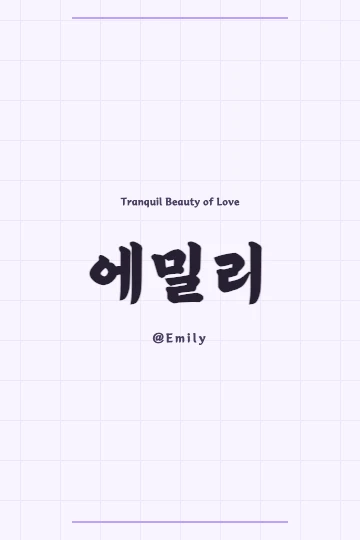
Korean Name (한글 표기): 에밀리 (E-mil-li)
Chinese Characters (한자): 愛謐麗
Hanja Pronunciation (한자 발음): 애밀리 (Ae-mil-li)
Simple Meaning: Tranquil Beauty of Love
Story Meaning: This name paints a picture of a soul graced with profound affection, whose serene presence and inherent beauty bring a quiet harmony to their surroundings.
Unveiling the Layers of Meaning: Emily's Essence
The name Emily, known for its gentle strength, finds a profound and poetic interpretation in Korean. Beyond a mere phonetic match, its Hanja rendition seeks to capture the very spirit of the name, suggesting a personality imbued with grace and a serene inner world. It speaks to a person who naturally emanates peace and warmth, touching those around them with an understated yet powerful beauty rooted in affection.
The Art of Hanja: Crafting 愛謐麗 (애밀리)
Choosing the perfect Chinese characters (Hanja) for a Western name is an intricate art, balancing phonetic accuracy with beautiful, relevant meanings. Among the many beautiful combinations for 'Emily', 愛謐麗 emerged as the most fitting and evocative choice, resonating with a harmonious blend of positive attributes.
愛 (Ae): This character signifies 'love' or 'affection'. It sets the foundation of the name, emphasizing a loving nature and a heart full of warmth.
謐 (Mil): Meaning 'peaceful' or 'tranquil', this character brings a sense of serenity and inner calm to the name, suggesting a composed and gentle spirit.
麗 (Li): Representing 'beautiful' or 'splendid', this character completes the elegant imagery, highlighting inherent grace and outward charm.
Logic: '愛'(Ae) means 'love', '謐'(Mil) means 'peaceful/tranquil', and '麗'(Li) means 'beautiful', together symbolizing a person whose inherent beauty and loving nature inspire a serene and harmonious existence.
Personalizing Your Name: Creative Inspirations
Knowing the profound Hanja meaning of Emily opens up a world of creative possibilities for personalization, allowing you to carry its essence in unique ways:
Custom Jewelry or Accessory Engraving: Imagine a necklace pendant or a bracelet subtly engraved with '愛謐麗' or '에밀리'. It transforms a simple accessory into a personal talisman, a quiet reminder of your name's tranquil beauty and loving core.
Art Print or Poster for Room Decoration: Commissioning a stunning art print featuring your name in elegant Korean calligraphy, perhaps alongside its Hanja, can create a deeply personal and aesthetically pleasing focal point for your living space. It's a daily inspiration of your name's rich meaning.
Beyond Transliteration: A Recommended Korean Name
For those seeking a Korean name that offers both phonetic familiarity and a natural feel, 예리 (Yeri) stands out as a beautiful and modern choice. While not a direct translation, 'Yeri' resonates with a similar gentle sound and is a beloved name in Korea, often associated with qualities like intelligence and beauty. It provides a lovely bridge between the cultures, allowing an Emily to feel at home with a Korean identity.

Frequently Asked Questions about Emily in Korean
How is Emily written in Korean?
Emily is phonetically written in Hangeul (the Korean alphabet) as 에밀리 (E-mil-li).
What are the Hanja for Emily and their meaning?
We chose the Hanja 愛謐麗 (애밀리). 愛 (Ae) means 'love', 謐 (Mil) means 'peaceful/tranquil', and 麗 (Li) means 'beautiful'. Together, they symbolize the 'Tranquil Beauty of Love'.
Can Emily be a Korean name?
While 'Emily' itself is a Western name, its Korean transliteration '에밀리' is commonly used by Koreans when referring to someone with that name. For a natural-sounding Korean name with similar vibes, we recommend 예리 (Yeri).
Why is the pronunciation of Hanja different from the Korean transliteration?
Korean transliteration (에밀리) aims to mimic the original English pronunciation as closely as possible using Hangeul. Hanja (愛謐麗), however, are Chinese characters adopted into Korean, each with its own traditional Korean reading (애밀리). We select Hanja based on their sound and profound meaning, often finding a beautiful harmony that may slightly differ from the direct phonetic transliteration of the English name.


